International acclaim and Local News

Welcome. On this blog you will find writings and videos on topics of Asia & human rights issues. Please feel free to comment on anything and follow me on Twitter! "Until they become conscious they will never rebel, and until after they have rebelled they cannot become conscious" - George Orwell - 1984 Praise for our documentary 'Train to Lhasa':- "Great work, this is really cool to see as an outsider. We really see nothing of Tibet" - jamminthedayaway | "Thank you for making this documentary video. The outside world needs to see what China is doing inside Tibet - to Tibetans" - TibetArchive | "By far the best up and close video tour of Potala palace. Enjoyed watching it. Great job." - tnyima | "I look forward to watching the other parts and to the day when such videos can be viewed in the Middle Kingdom without censorship" - Wizenedcompass | "Just can't wait to visit my birth place! I am crying watching this. Thank you for your lovely video" - Yiney86 | "Very informative documentary that definitely shows what China is doing in Tibet - doing to Tibetans" - TibetArchive | "I was completely captivated by this... i hope to travel to Tibet at some point in the future. Thank you for the amazing look into that area and keeping awareness on this mostly ignored part of the world" - spdybike | "Amazingly real, thank you" - lauriwarmigu | "China is dissolving Tibetan life and culture from every angle. Wow, thank you." - werspansio | " Thank you for this video and it's really sad to see how the Chinese government treats the Tibetans" - adamtashi | Praise for our documentary 'Across the Plateau':- | "Well done and very interesting. I've enjoyed all your documentary parts so far, each one better than the previous one. Congratulations!" - stonetube1000 | "Thank you, these videos filled my eyes with tears and I love my country Tibet. We need more support from the world. Thank you for these beautiful and rare pictures" - adamtashi | "Thank you for making this documentary and for not exposing any Tibetan people you talked to, as you know the consequences" - TibetArchive | "Thank you so much. I felt like I was traveling with you guys and seing all those holy and beautiful places. Thanks for this documentary and your support for Tibet" - 123klpd | "Thank you so much for uploading these amazing videos" - yangphel | "Impressive!" - venuschampagne | "I enjoyed it so much! I'll be going to Tibet and this is very helpful!" - marikojacinto | "Thank you my dear brothers. Your beautiful hard work has contributed to the betterment of humanity and of course helped in attaining equality, justice and respect for basic human rights and cultural freedom. On behalf of all humans who ever lived and will live, I thank you" - Iknowtibet | Praise for our documentary 'Through the Himalayas':- "Thanks for sharing. I will be heading to Nepal and Tibet in October and this series has given me an insight of what to expect" - leimaogowchor | "Great series!! Really enjoyed it! Thank you!" - stonetube1000 | "We're heading to Tibet and Mount Everest base camp next month! We're so happy to see such a detailed video, with lots of good advice along the way. Thanks guys!" - venuschampagne | "Thank you so much. I was able to travel to Tibet sitting right here in my room. My heart breaks for the Tibetan people. Thanks for going and for posting your videos" - Bunten3123 | "Wow what a beautiful world, Tibet. I appreciate both guys who filmed these. You guys are lucky to see Tibet- just hoping one day I will go back to my country, Tibet. Good luck on your journey" - norbu1987 | "Great job guys.... it was beautiful... and you guys are so lucky to see all those holy places.... all the best...thanks for supporting Tibet and keep up the good work..." - 75jampa | "Thanks a lot for a wonderful movie - all my family watched it. It is amazing. Peace and hugs" - rusbolt75 | "Great! Thank you for your courage and your determination in doing this documentary! We Tibetans and friends of Tibet are grateful. Thu je nang and Kadrinche!" - ChoeJhungLhaMola | To watch the acclaimed series online, just CLICK HERE

Friday, 17 December 2010

Hardly a photographer, but...


HAVING been fortunate enough to travel to a significant number of incredible places in the world, there are many moments which have stayed with me until now, and will likely do so for the rest of my life.

A trusty IXUS 50 Digital Camera -
 All you need!
Though most of the time these instances are too fleeting or personal to allow a camera to steal them, occasionally I have been able to trap a brief instant between my shutters.

I shall occasionally post a short selection of a few moments which - for one reason or another - I felt demanded to be caught.

I would greatly appreciate comments or suggestions on this one...
All pictures: JOE BRISCOE

_______________________________________________________________________________
_______________________________________________________________________________

India, 2009:

WHEN arriving at a place as famous as the one featured in this photograph, the temptation to shoot it from every possible angle grabs you, and you spend a good hour taking virtually the same picture again and again. After the initial urge to do this passes and you feel confident with your 'safety' images, then you begin to look around.

Suddenly the area ceases to only contain the world's most famous building, and as if by magic all the life around you appears. Families, workers, security guards, children playing, people looking lost - even lovers gazing at each other.

And before you know it, you're looking at an incredibly touching moment, a defining second in the life of a small child. Their first trip to the international symbol of their country. A day which will be burned into their memory for the rest of their life.


A family in India stares upon the Taj Mahal for the first time.
I could see the little girl would remember this day for the rest of her life.
All pictures: JOE BRISCOE

And as the family of three stepped through the gates and were confronted with their first view of the world's most famous monument to love, I raised my camera and caught it forever. Though only I saw the face of the little girl as her eyes gradually settled on the landmark, hopefully from this picture you can imagine the sparkle in her shining little eyes too.

I am not ordinarily one for deliberately out of focus photographs, but in this case I very quickly decided that the building itself remained instantly recognisable when out of focus. I took a number of similar pictures both in and out of focus, but this one seems to retain the scale and dominance of the Taj Mahal the best.
_______________________________________________________________________________

Tibet, 2009:

HOW to photograph the repression of a people? When cautiously exploring Tibet, a place which feels every bit an occupied country, chances to speak to people freely are few and far between. Most will not say anything at all, and those that do are guarded and vague. Add to this the fact that one is accompanied, supposedly at all times, by a 'minder' appointed by the government. Although my colleage and I did managed to give said 'guide' the slip for a while, the massive police and military presence on every street makes one constantly think twice about doing anything undesireable.

And so, for the most part, I was reduced to shooting the things which our guide pointed to.

The video footage I gathered whilst in Tibet however remains a source of much amusement to me.  Each time an armed guard or sniper hidden among the rooftops noticed I was filming him, his expression would change to a look of terror and shout at me while waving his hands frantically. I of course would slowly point the camera away, trying to make it seem like I had simply been panning past him all along.

A Tibetan mother and daughter are fascinated by the first 'westerner' they've
ever seen. Behind them, the infamous Sera monastry - nestled
beneath the mountains which encircle Lhasa.
All pictures: JOE BRISCOE

The above picture though, is a still I managed to take while attempting to get inside one of the buildings of the infamous and now dangerously symbolic Sera monastry - one of the 'great three' Gelukpa university monasteries of Tibet, and particularly famous for nurturing rebellious monks.
As I looked around the exterior of the old Tibetan building and beyond to the mountains I caught sight of a mother and daughter, secretly watching me. As is often the case in Asia, a moment passed between us, I snapped the picture and we shared a smile.

Although the reasons for the devout buddhists attempting to enter the monastry couldn't have been more different to those of this old British atheist, for a second we were all just people trying to enter a very special and symbolic place.


The sun, symbol of Tibet, streams down through the roof of Sera monastry,
 illuminating the dust which has remained trapped in the gloom for an age..
All pictures: JOE BRISCOE

Once inside, the monastry was otherworldy. When within the main hall, I was transfixed by the devotion of the monks and tried desperately to store every second of their heart-trembling chanting in my memory - thinking perhaps that I could store such raw energy and peaceful defiance deep inside for myself.

Soon however, my colleage and I evaded our minder and strayed out - poking our noses around the restricted areas of the monastry. Restricted by the Chinese government, that is.

One of the wonderous little places we stumbled upon is featured in the above photo. An absolutely incredible little room which, as I recall, produced all the food for the thousands of monks who could be staying at the monastry at one time. But the room was so much more than that. It was a snapshot of a different age - littered with ancient Tibetan artefacts and kept in a way that could only have been done in Tibet. The smell of butter lamps soaked out of every wall, and, like the most wonderful film set, the sun splashed down through the roof, making the centuries old dust dance and swim. The ancient, musty air itself alive with the memory of happier times and the experience of tragedy.

While a photo can never contain all that, this one at least puts the basic image into your mind.

_______________________________________________________________________________


Indonesia, 2010:

AS always when travelling, the people you meet are always the most interesting thing. But sometimes, simply watching people without talking to them, and observing their actions - trying to guess where they are from and what they are all about - is just as rewarding as speaking to them.

A lone woman, accompanied by nobody, yet basking in the
intense rays of one of natures most spectacular shows.
All pictures: JOE BRISCOE
As hundreds descended onto the beach at Bali to watch the world renowned sunset, I instead turned my attention to the many who, like me, were watching the spectacle by themselves.
Alone with their thoughts, living their own adventure and yet surrounded by so many strangers.

The sunset, needless to say, was awe-inspiring, but not half as beautiful as the incredible mixture of cultures and nationalities which joined together each night to share the same experience.

I snapped many pictures of all kinds of people over those nights, but the one I have included above is one of the better composed images. Although shooting sunsets is relatively easy, the lone woman I had been watching, seemingly in her own little world with something on her mind, stepped into the sun at precisely the right moment.

And I grabbed it.
_______________________________________________________________________________


China, 2007:

IN a country where gaudy nationalistic monuments and historical shrines to a long-dead culture exist on every street corner, it is something of a rarity to be impressed by them in China anymore. And yet the sheer scale and simple brilliance of the Xi'an city walls still manage to make me smile.

Imagine an entire modern city, surrounded by vast battlements which encircle the entirety of it. While outlying districts have sprung up on the other side of the wall, Xi'an can still be easily negotiated by simply knowing where you are in relation to the wall. There are only a few entrances and exists to the city, meaning that even today, the city could be defended in exactly the same way as a thousand years ago.

And while the walls have of course been rebuilt many times since then, they remain grand and imposing during the day.


But, as the Chinese have a bad habit of doing, by night they are illuminated by somewhat tacky, red (of course) lights. But for once, rather than turning away from them, I was momentarily taken by the resulting affect.


The South gate to the city walls of ancient Xi'an.
Imperialistic, imposing and enchanting.
All pictures: JOE BRISCOE

The picture above is a section of the South Gate, taken a few weeks before Chinese new year in early 2007. If nothing else, I was quite pleased with the way the colour turned out, especially considering the camera used and the fact that it was taken at night.

Who would have thought that Chinese imperialism could be so pretty...

_______________________________________________________________________

Tuesday, 14 December 2010

On it's 60th birthday, UN Refugee agency pleads to Cambodian government..... while 62 Vietnamese pray...

Of all the countries in South East Asia, it is Cambodia which stays with you longest after you leave.


The time I spent there sent me head-over-heels in love with the place.

Small border towns like this one straddle the hardly
distinguishable line between Vietnam and Cambodia.
All pictures by: JOE BRISCOE

The muted tranquility of the jungle, and the mysterious lawlessness of the towns hint at both great danger and excitement - surrounded by a deeply compassionate people.

Internationally, the country seems to somehow exist outside the rest of the world, and when speaking to the ordinary people who live there, one can sense that they each carry a weight of personal grief on their shoulders.

Although Cambodia rarely makes it into the headlines, it is a country where the tragedies of it's past remain inseparable from it's politics of today.

Any news which does reach 'western' ears usually concerns the ongoing attempts to bring the surviving leaders of the Khmer Rouge to justice.


Despite being poor, places such as the Angkor temples have helped
Cambodia nurture a notable tourist industry.
All pictures by: JOE BRISCOE

The head of the notorious Tuol Sleng prison, nicknamed 'Dutch' was recently tried, and the occasional articles written on the country almost always deal with how the country is still wrestling with the atrocities of it's past.

Very rarely however, do positive reports of the country make it into the papers. Absent are stories of  Cambodia's growing backpacker industry, fuelled by large numbers of visitors from China and Thailand. Little too is ever mentioned of the government's continuing efforts to stamp out sex-tourism and child prostitution.

In the eyes of the media, it seems Cambodia is destined to remain the downtrodden, war-torn underdog that it so comfortably sees itself as being.

But as Cambodia struggles to find it's place in the world, contrary to it's representation in the media, it is becoming increasingly influential amongst it's neighbours, standing up regularly to the unreasonable demands and bullying tactics of Thailand on a number of issues.

Today however, Cambodia has caused considerable controversy with the news that it is closing a centre in Phnom Penh, set up for Vietnamese refugees who are at risk from their own government. After the Vietnamese government cracked down on protests against land confiscation, many escaped over the border and sought refuge in neighbouring Cambodia.


Sadly, sanitary conditions in Vietnam remain poor. These children live
along the Mekong River, close  to the border with Cambodia.
All pictures by: JOE BRISCOE
Among the refugees are also groups who claim they will face religious persecution if forced to return to Vietnam.

It will seem a particularly unpleasant coincidence to the UN that this news was released today - exactly 60 years to the day since the creation of the United Nations High Commissioner for Refugees.

The UN Refugee agency was created in the wake of the Second World War to help the 40 million people in Europe who had been displaced by the conflict.

It was only expected to remain in existence for a short time - and yet sixty years later, it continues to help people from all nationalities who are, for whatever reason, without a country to return to.

The war in Bosnia brought about the first time that the UNHCR assisted people actually during armed conflict, and they have, over the years, been the recipient of two Nobel Peace Awards.

The organisation was clearly surprised by Cambodia's decision to close this particular refugee camp, clearly aware of what type of reception the Vietnamese government would give those 62 people, should they be forced to return.

Kitty McKinsey of the UNHCR told the BBC: "We have asked the Cambodian government to give us more time to find a long-term solution for these 62 individuals who are at that site, and we hope that the Cambodian government will give us a favourable reply,"

But the Cambodian Foreign Ministry seems to be serious about its intentions. It was quoted as saying:
"If we don't tell them to close the site, the work of the UNHCR will be prolonged endlessly."


Even in Saigon many still struggle
to make a living on the street.
All pictures by: JOE BRISCOE

While this is a pragmatic and unfortunately fairly accurate appraisal of the situation, it is surprising that a country so experienced in the realities of fear and repression would seek to send innocent people back to certain misery.

 I myself can often be heard to praise the government in Vietnam . This is probably because they seem unwilling (or unable) to restrict their people to quite the frightening extent that the governments of both China and North Korea do, despite all three countries having once been cut from the same ideological cloth.

The stark reality is that the fate which would await those innocent families would not, to put it lightly, be a nice one. 

Traveling through Vietnam is an eye-opening experience. Alien landscapes surround you and poverty - the equal to that in Cambodia - is seen all over, be it in the villages in the centre of the country, or on the street corners in Saigon. Although the countries larger cities, Hanoi and Ho Chi Minh seem more affluent and are undoubtedly more developed than Phnom Penh or Siam Reap across the border, the quality of life which you encounter throughout both subtropical paradises is equally abysmal.


Many families rely on the polluted rivers of Vietnam.
Few are ever likely to escape these conditions .
All pictures by: JOE BRISCOE

And while Cambodia suffers from constant allegations of corruption within the government, at least it is, to some extent, answerable to it's people. Vietnam, for all it's bars and nightlife, remains a secretive state - it's rulers deciding laws behind closed doors, and it's hold on the people unfaltering.

To march those poor souls a few hundred metres across the border and into Vietnam would be irresponsible and unforgiveable, and I can only guess at why Cambodia has decided to do this. In an attempt to project it's small but steadily increasing power in the region, the government has decided to put its foot down on this matter, attempting to hoist Cambodia's image into that of a hard, worthy opponent. Presumably in the hope that Thailand is watching.

But is sending good vulnerable people towards their death and turning your back to it really something that Cambodia of all countries should be doing?

Vietnam surely hopes so.
 
The tension which exists between these two outcast countries is palpable, with each country's distaste for the other startlingly obvious in conversation. The complicated relationship which they share stretches back many years, the distrust ingrained. While it was Vietnam who ultimately cleared up the mess left by the Khmer Rouge, effectively 'liberating' Cambodia, most Cambodians see the resulting period as highly unfair and the influence of the government in Hanoi as extremely repressive.

And though the UNHCR is currently pleading to the Cambodian government for more time, it's possible that they either know something we don't, or have faith in Cambodia, much as I always have.

"They haven't sent them back yet, so let's not get ahead of ourselves"  said Kitty McKinsey of the UNHCR.

Sunday, 12 December 2010

Culturally Diverse News Anchors!!

Ronny the Yank and Mrs. Zhang read the news at ten!
Just don't mention Liu Xiaobo!!!

China and India have a little chat about.... politics...

A little video I made. I hope it gets the point across...
Please tell me your thoughts below!

Thursday, 9 December 2010

Who on Earth is Carl von Ossietzky?


You're watching BBC news and suddenly the TV screen goes blank. You flick over and the other channels are working. You get to Channel 4 news and suddenly - blackout again.

Carl von Ossietzky - 1915
 You sit down at the computer, bring up your favourite news website and for some bizarre reason it says the 'connection has been reset' and refuses to take you there. How strange - it was working fine yesterday.

Welcome to China.

A good friend in Washington contacted me yesterday to point me in the direction of an article in the Washington Post. Although the article was interesting and pretty on-the-money, buried in the text was a small piece of information that most other news corporations either didn't know about, or had neglected to mention. It concerned a man by the name of Carl von Ossietzky.

[NB. the Media have since picked up on it]

I will reveal the significance of this little-known German a bit further down.

In a few hours, the Nobel Peace Prize ceremony will be held. It will not however be handed out to winner of the award Chinese dissident Liu Xiaobo, as he remains in a Chinese prison - and will do for many more years.

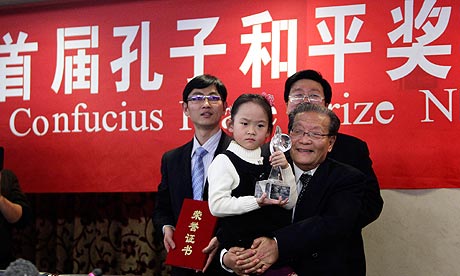
China has recently been outraged by the decision to award Mr. Liu the honour, even going so far as to try and discredit the Nobel committee by creating their own 'Confucious Peace Prize'.

But is the situation in China really all that bad?

As dissident Ai Wei Wei said on the BBC yesterday "People can be monitored, their phones can be tapped and you can be followed. They can find you, they can intimidate you or scare you - or wrongly accuse you," he added.

In THIS previous post, I talked about the petty childish actions of the Chinese government, and the events of the last twenty-four hours have proved me right. The hilariously shambolic Confucious Peace Prize which the Chinese Government cobbled together did make me laugh for a long time, whilst also saddening me by how pathetic it was.
 
A girl named only as an 'angel of peace'  holds the first Confucius peace prize trophy
An unnamed girl dubbed the angel of peace accepts the Confucious Peace
 Prize on behalf of the winner Lien Chan who didn't attend the ceremony
and said he only learned of the award through media reports.
 While the BBC website's Chinese version has always been blocked within China, the main English site was made available a few years ago. It was subsequently blocked during the Beijing Olympics, and became available again soon after.

But yesterday the entire BBC online service, along with BBC World News (only available via satellite anyway) was blocked throughout China. One person I spoke to in Shanghai, who did not wish to be named, told me what they thought this means: "Sometimes things like this happen in China, but Shanghai is usually the last place for websites to stop working. This time it happened at the same time.

"I use the BBC website every day and find it a very useful way to hear about news which China doesn't think is important.

"The reason BBC and other news websites have stopped working is because the government feels embarassed about Liu Xiaobo. He has become famous by revealing the truth about the government. But they can just cover it up and lie. Most people don't know."

So while Aung San Suu Kyi offers sympathy to Mr. Liu, the BBC works its diplomatic magic, and the organisers of the Nobel Prize attempt to clarify their position, China will just have to sit and watch uncomfortably as the governent loses face in front of the world later today.

Another Tiananmen Square veteran, Wu'er Kaixi will collect the award on behalf of Mr. Liu, and there's nothing that the Chinese government can do.
It's just a damned shame that Liu Xiaobo won't be able to collect the prize himself.


So now, the question you've all been waiting for...

Who on Earth is Carl von Ossietzky?

 In 1935, the Nobel Peace Prize was awarded to German pacifist Carl von Ossietzky. Sadly the laureate was unable to attend the ceremony to collect as he was in prison.

When Liu Xiaobo doesn't attend the ceremony today, it will not be the first time a laureate has been unable to collect.
And who was it that had imprisoned Mr. von Ossietzky - the winner of the Nobel Prize for Peace?
The Nazis, of course.
 

Carl von Ossietzky -
Nobel Peace Prize winner 1935
Pictured in a concentration
 camp in Esterwegen, 1934

Liu Xiaobo - Nobel Peace Prize winner 2010
Currently imprisoned in China.


CONGRATULATIONS LIU XIAOBO!
WINNER - NOBEL PEACE PRIZE 2010