International acclaim and Local News

Welcome. On this blog you will find writings and videos on topics of Asia & human rights issues. Please feel free to comment on anything and follow me on Twitter! "Until they become conscious they will never rebel, and until after they have rebelled they cannot become conscious" - George Orwell - 1984 Praise for our documentary 'Train to Lhasa':- "Great work, this is really cool to see as an outsider. We really see nothing of Tibet" - jamminthedayaway | "Thank you for making this documentary video. The outside world needs to see what China is doing inside Tibet - to Tibetans" - TibetArchive | "By far the best up and close video tour of Potala palace. Enjoyed watching it. Great job." - tnyima | "I look forward to watching the other parts and to the day when such videos can be viewed in the Middle Kingdom without censorship" - Wizenedcompass | "Just can't wait to visit my birth place! I am crying watching this. Thank you for your lovely video" - Yiney86 | "Very informative documentary that definitely shows what China is doing in Tibet - doing to Tibetans" - TibetArchive | "I was completely captivated by this... i hope to travel to Tibet at some point in the future. Thank you for the amazing look into that area and keeping awareness on this mostly ignored part of the world" - spdybike | "Amazingly real, thank you" - lauriwarmigu | "China is dissolving Tibetan life and culture from every angle. Wow, thank you." - werspansio | " Thank you for this video and it's really sad to see how the Chinese government treats the Tibetans" - adamtashi | Praise for our documentary 'Across the Plateau':- | "Well done and very interesting. I've enjoyed all your documentary parts so far, each one better than the previous one. Congratulations!" - stonetube1000 | "Thank you, these videos filled my eyes with tears and I love my country Tibet. We need more support from the world. Thank you for these beautiful and rare pictures" - adamtashi | "Thank you for making this documentary and for not exposing any Tibetan people you talked to, as you know the consequences" - TibetArchive | "Thank you so much. I felt like I was traveling with you guys and seing all those holy and beautiful places. Thanks for this documentary and your support for Tibet" - 123klpd | "Thank you so much for uploading these amazing videos" - yangphel | "Impressive!" - venuschampagne | "I enjoyed it so much! I'll be going to Tibet and this is very helpful!" - marikojacinto | "Thank you my dear brothers. Your beautiful hard work has contributed to the betterment of humanity and of course helped in attaining equality, justice and respect for basic human rights and cultural freedom. On behalf of all humans who ever lived and will live, I thank you" - Iknowtibet | Praise for our documentary 'Through the Himalayas':- "Thanks for sharing. I will be heading to Nepal and Tibet in October and this series has given me an insight of what to expect" - leimaogowchor | "Great series!! Really enjoyed it! Thank you!" - stonetube1000 | "We're heading to Tibet and Mount Everest base camp next month! We're so happy to see such a detailed video, with lots of good advice along the way. Thanks guys!" - venuschampagne | "Thank you so much. I was able to travel to Tibet sitting right here in my room. My heart breaks for the Tibetan people. Thanks for going and for posting your videos" - Bunten3123 | "Wow what a beautiful world, Tibet. I appreciate both guys who filmed these. You guys are lucky to see Tibet- just hoping one day I will go back to my country, Tibet. Good luck on your journey" - norbu1987 | "Great job guys.... it was beautiful... and you guys are so lucky to see all those holy places.... all the best...thanks for supporting Tibet and keep up the good work..." - 75jampa | "Thanks a lot for a wonderful movie - all my family watched it. It is amazing. Peace and hugs" - rusbolt75 | "Great! Thank you for your courage and your determination in doing this documentary! We Tibetans and friends of Tibet are grateful. Thu je nang and Kadrinche!" - ChoeJhungLhaMola | To watch the acclaimed series online, just CLICK HERE
Showing posts with label Travel photography. Show all posts

Thursday, 23 February 2012

Secret Photo: Freedom?

This image from 2009 shows a Chinese security official closely watching
a group of Tibetans on the slopes of the Potala Palace.
Chinese forces were present wherever we saw small gatherings such as this.
Even small gatherings of people are controlled by the Chinese in Tibet.
Photo by: Joe Briscoe, 2009

Any photos used must be properly credited. 

Sunday, 22 January 2012

Secret Photo - Watched every moment

A cropped version of this photo is already available elsewhere on this blog, but here is the full version, clearly showing the sniper in relation to the Jokhang temple.
You also get a better idea of just how oppressive the snipers presence is.


Overlooking the Jokhang temple and the Barkhor,
a Chinese sniper sits in wait - January 2009
Photo by Joe Briscoe
Any photos used must be properly credited.

Friday, 22 July 2011

PART 3: THROUGH THE HIMALAYAS

Part three of the documentary which charts a journey across "China's Tibet"
and through the Himalayas to the Nepalese border.

       Part 3: Through the Himalayas      
First half


Second half

Scroll down to go back and watch parts I & II

What did you think of the documentary?
Have you been to Tibet? What were your experiences?

We would love to know what you thought of this documentary,
so do please comment on the episode below....

Monday, 18 July 2011

PART 2: ACROSS THE PLATEAU

Part two of the documentary which charts a journey across "China's Tibet"
 and through the Himalayas to the Nepalese border.

         Part 2: Across the Plateau         
First half

Second half

PART III: Through the Himalayas COMING SOON...

What did you think of the documentary?
Have you been to Tibet? What were your experiences?

We would love to know what you thought of this documentary,
so do please comment on the episode below....

Thursday, 14 July 2011

PART I: TRAIN TO LHASA

Part 1: Train to Lhasa

First half

Second half

PART II: Across the Plateau COMING SOON...

What did you think of the documentary?
Have you been to Tibet? What were your experiences?
Please comment on the episode below....

Wednesday, 9 March 2011

Free Tibet - 52 YEARS LATER

SECURITY in Tibet has been tightened, and suffocating restrictions on travel in the region have been imposed ahead of the anniversary of the Tibetan Uprising of 1959.

The area has effectively been closed to foreigners, and where once it was very difficult to get entry permits to the roof of the world, it is now virtually impossible.
 
Cosham: Do people in England really care about campaigns
such as Free Tibet?

Back in early 2009 when I was there, it was possible to slip away from your minders and speak to people - even though it was only 8 or 9 months after the 08 riots. It was strictly forbidden of course, but certainly do-able, as we found out.

But at this time of the year, when the anniversary of the largest challenge to Chinese rule comes around, the Chinese police show up for work with just that little extra fire in their step - their fists clenched just that bit tighter.


Emotions are high among the Tibetans still, though hearing that from someone inside Tibet is rare. The Dalai Lama is still blamed by the government for virtually every incident that happens, even though he has made it clear multiple times that he no longer seeks independence - just meaningful autonomy.

Lhasa - the capital of Tibet and the site of regular
protests against Chinese rule.
Photo by: Joe Briscoe

But back over here in England, when many are taking to the streets and waving banners and boards more likely to read 'Stop the cuts!' rather than 'Free Tibet' does anyone actually care anymore?

When the race for labour leader was nearing it's final stages last year, I must say that even though my head knew David Miliband to be the best choice, I still hoped against all hope that he would be beaten by his brother.
Why?

Because of this article in the Telegraph, dated January 9, 2010.

An excerpt:
...a remarkable statement from the Foreign Secretary, David Miliband, slipped out on the FCO website on October 29 2008, just before representatives of the Dalai Lama were due to hold talks in Beijing on the future of Tibet.
Buried in the statement was Britain's recognition for the first time that, like "all other members of the EU… we regard Tibet as part of the People's Republic of China". The historic significance of this change was not lost on Beijing, since until then Britain, with its unique role in Tibet's history, had for 100 years been very careful not to recognise Chinese sovereignty over Tibet. The group known as Free Tibet noted that Miliband's concession gravely weakened the position of the Tibetan envoys without getting anything in return – commenting how extraordinary it was that Britain should have "rewarded China in such a way in the very year that China has committed its worst human rights abuses in Tibet in decades, including killing and torture".


The Chinese military constantly patrols the Barkhor Square in Lhasa - the
spiritual home of Tibetan Buddhism and site of regular protests.
Photo by: Joe Briscoe

In one move, Miliband had undermined what so many people had been working so hard towards. Whether there were any gains from the concession we don't know. What did the Chinese offer our government in return for such a statement? But, whereas an admission of such a kind about a multitude of places would have made national press and ruffled feathers, this one slipped past virtually unnoticed. The Telegraph and the New York Times being the two major exceptions.


So the mighty Free Tibet campaign has failed. There is afterall, no hope.

Not so fast.

While the peace loving Dalai Lama grows old and frail and talks repeatedly of 'retirement', a younger generation of Tibetan youths outside of Tibet are growing impatient. They are less tethered to the anti-violence mantras of their spiritual leader, and more outraged than ever before at their lack of a home land. And if the hope of a free China seems so distant, then it is in the hands of this volatile and firey younger generation that the future of Tibet rests.


Lhasa: Tibetans, gathered outside the Jokhang temple in the city centre.
Photo by: Joe Briscoe

Whether or not that is a good thing I can not say - only time will tell. But what would restore my faith in the people of England and the west in general, is an effort to show solidarity. To breach the almost impenetrable wall of lies and propaganda that encircle China and Tibet, and to prove to the world and to ourselves that we care about more than just budget cuts. That while we are able to protest against such problems here at home, we are also able to stand up for those who not only have no libraries or public toilets, but even don't have their own country, or basic human rights for their families.

Today is March the 10th - a very special day in the history of a very special country.
A country which remains bound and chained and tortured.
And while John Humphries may have been suckered in, those of us that truly know China are not fooled.

Free Tibet indeed.
What a day that would, and still could be.
 
England: Cosham railway station.

Monday, 31 January 2011

China; taking our breath away...

WHAT could be more unsettling than the thought that a 'Communist' totalitarian superpower may actually posses military hardware to match that of the democratic countries of 'The West'?

Obviously with such ongoing critiscism of the wars in Iraq and Afghanistan that may be a controversial opening in itself, but nobody can deny the increasing relevance of China's military in the asia-pacific region and indeed in the world today.

Photo apparently showing prototype of Chinese-made stealth plane
It is highly illegal to photograph military hardware in China,
 but a leaked photo made the world aware
of the Chinese J-20 prototye
When Hu Jintao finally admitted that China was indeed developing their own stealth fighter- the J-20 (seemingly named after a soft drink), alarm bells rang for many around the world. Although it was well known that the Chinese were actively pursuing their first aircraft carrier - something which would give them considerable bargaining power in their constant maritime disputes and border clashes - the thought that something as advanced and 'American' as a stealth jet was being built by them hadn't even entered the West's collective mind.

It wasn't long, however, before fingers were pointed and the familiar cry of 'knock-off' could be heard. China's reputation for copying successful products, illegally manufacturing them and selling them domestically is well known, and it seemed this wasn't just limited to shanzhai ipods and dodgy clothes brands. Soon came claims that the technology behind the Chinese J-20 Stealth was stolen from a US F-117 stealth jet which was shot down over Serbia. Of course the Chinese rejected these claims, as they always do, but it is not difficult to imagine Beijing going out of it's way to acquire the wreckage for their own ends.

And today, a rather humourous chapter is added to the ongoing coverage of China's air force. The hilarious news that China's state-run broadcaster- CCTV -  has tried to pass off scenes from the 80s movie 'Top Gun' as video footage of their own air force have done little for their credability on the world stage.

The Wall Street Journal has compared the 'news' footage with the movie scene in question:


So, as China seeks the attention of the rest of the world, trumpeting their advances in technology and military might, it is rather unfortunate for them to be caught attempting to pass off Hollywood movie footage from 30 years ago as footage of their own air force.

Beijing often utilises it's air force in displays of power - hoping that the sheer scale and noise of the jets will impress and intimidate the people enough - it is a tactic they employ on a daily basis too. It is not uncommon to be forced to stop a conversation in Shanghai's city centre and wait for the deafening noice of a fighter jet, passing overhead, to fade.

The military maintain a constant presence over
 cities such as Shanghai - Footage by Joe Briscoe, 2010

The oppressive 'big brother' in the sky is something that most city residents are used to, hardly noticing the warplanes circling above. But the younger generation seem to be more than aware of it.
One student I spoke to in Shanghai, who wished to remain anonymous, said: "It always comes over in the class time. So many times we have to wait for it to go over so we can hear the teacher. It's so unnecessary I think. Are we at war with someone?"
But how important does this 12 yr old think it is to have such a rapidly expanding military?: "China needs to be strong" he said, "but so many poor people are more important I think. Give them a house and doctor first, then we can spend on other things."

Fighter jets constantly circle heavily populated areas of China - 
an ominous reminder of power to the people below.
- Footage by Joe Briscoe, 2010

So while the country continues its long quest for an aircraft carrier and presses forward with designing it's own fleet of stealth jets, it seems that the sharp-eyed youth of today who spotted the cinematic addition to their news report and the students who grow tired of the military presence interrupting their classes are less than excited by the prospect of more money being spent on airborne machines of death.

Even if Tom Cruise is, unknowingly, the posterboy.

Saturday, 8 January 2011

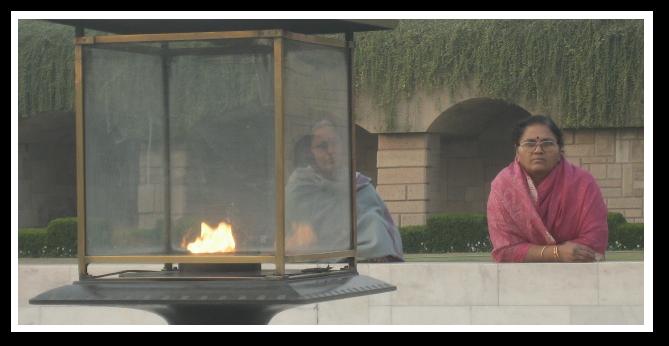
राज घाट - A moment of peace in India's Raj Ghat

Delhi has problems. Nobody can deny that.


It is not only dangerous, but feels dangerous too. While recently announced figures show that the crime rate in Delhi in 2010 was down compared to 2009, the number of cases nevertheless remained high at 48,161.

The quality of life for thousands living there is unacceptably poor, the noise and pollution is oppressive and those not used to the city will likely find little to recommend it, either as a backpackers stop or a holiday destination.

But there is a place in Delhi where the constant noise gives way to silence. The countless tourist scams are respectfully left outside and the unfaltering tide of traffic leaves this oasis - tucked against the banks of the river Yamuna - in relative seclusion.

In fact, at the risk of sounding overly dramatic, राज घाट, - or Raj Ghat - is the closest you will find to absolute serenity inside Delhi.


 When Mahatma Gandhi died in 1948 he was cremated on this site, and it remains to this day an undulating, joy-filled park with a majestic central walled enclosure into which people are drawn for peace, contemplation and solace.


A black marble platform marks the spot of Gandhi's
cremation on 31 January 1948
Photo by: JOE BRISCOE

Indeed, gently strolling around the mini-mecca, it is difficult not to begin pondering the important questions in life.

As you stand there, staring into the eternally flickering flame which marks the spot where the father of modern India became one with the world around him, the world around you stops and time itself can pass you by. The utmost respect is seemingly demanded by the very stone walls which encircle the centrepiece, and an atmosphere of forgiveness and acceptance fills the air between those wandering around.

The very principles of Gandhi himself seem to have been contained in this rather special place.
One wishes they could be amplified and beamed from here around the rest of the world.

 à¤°ाज घाट - The eternal flame provides comfort
 to people from all over the world.
Photo by: JOE BRISCOE

 The flame, which is never extinguished, repeatedly draws a hushed reverance from those who peer into it - eyes which are shown countless shapes dancing and leaping within the glass.

The day of Gandhi's assassination remains the country's 'Martyr's Day', and the day of his birth, known as Gandhi Jayanti, is a nationwide holiday - but it is here that one is truly able to marvel at what the man achieved. To still be bringing calm and quiet to a corner of a city as noisy and harsh as Delhi, 63 years after his death, is a miracle itself. One which plays as a fitting and continuous epitaph to the effects that a single man had on a nation.

"...we will not see him again, as we have seen him for these many years, we will not run to him for advice or seek solace from him, and that is a terrible blow.."   - Jawaharlal Nehru 
 And while Nehru, in his radio address to the country, told the world of India's loss and it's inability to any longer go to Gandi for solace, it is worth remembering that even today, Gandhi and the simple, peaceful oasis of Raj Ghat continues to provide that tranquility for those who visit it. 
 Visit it, as everyone should.

Nowhere does a sunset say as much as it does at Raj Ghat.
Photo by: JOE BRISCOE


Thursday, 6 January 2011

Hardly a Photographer, but... 5

Permit me to share more of the photographs which for one reason or another, are significant to me.
____________________________________
LOCATION:     YEAR:
India, 2009

I was recently asked by a special someone I met last year in Asia what the most cherished moments of my time travelling were. I can only reply that on each and every occasion where I met someone new I was the lucky recipient of such warmth and kindness.

On many occasions I was able to stay in touch with the people I met, thanks to the wonders of the internet - and yet there were many more times where the people I was fortunate to spend time with, or travel with did not have internet access, or didn't even own a phone.

In these cases when you say goodbye to them, you know it really is goodbye. Forever, most likely.

Some I have pictures of, some I don't.


"Don't break my little heart"
Photo by: JOE BRISCOE

For me, this picture represents that final image of a person that you have in your mind - the one that stays with you after you leave and always pops into your head when you think about them.

And then you think...
I wonder what they are doing now...

Monday, 3 January 2011

Hardly a photographer, but... 4

Permit me to share more of the photographs which for one reason or another, are significant to me.
_______________________________________________________________________________
LOCATION:     YEAR:
Malaysia, 2010


MALAYSIA is incredibly diverse. Staggeringly so. You can, at any time, have a conversation with a native Chinese person about the Chinese new year celebrations, you can discuss mis-representation in government with ethnically India Malaysians, and you can bump into anyone else, from literally anywhere else on the planet and no topic is ever off the cards.

When travelling from China to Malaysia, this all comes as something of a refreshing shock - one minute you are in a country where the range of conversation topics is troublingly small and anyone who isn't Chinese gets mercilessly stared at, and then suddenly you are in Kuala Lumpur, where the more dangerous the conversation, the more they want to have it with you. And people will only talk to you if you are from another country.

Kuala Lumpur's Petronas towers, reflected in the side of another building.
Picture by: JOE BRISCOE
 This photograph is not symbolic, doesn't represent this glorious diversity in any way and was not taken with any skill at all. It is simply the glittering reflection of KL's most famous landmark in the side of another building. Anyone who was there could have taken this picture. Point and shoot.

I was just lucky enough to be there.

Monday, 27 December 2010

Hardly a photographer, but... 3

Permit me to share more of the photographs which for one reason or another, are significant to me.
_______________________________________________________________________________
LOCATION:     YEAR:
India, 2009

THE sheer number of people who use the holy river Ganges is staggering. Assuming there is no religious festival taking place in which case the crowds swell further still, there remains thousands of people who make a daily pilgrimage to the river bank to wash themselves, their clothes or their livestock. And whilst the river sustains life, it is also the vessel of death.


This scene is repeated all along the banks of the Ganges.
The river is an invaluable part of thousands of people's lives.
Picture by: JOE BRISCOE

The location for this particular photo is Varanasi, one of the oldest continuously inhabited cities in the world, and each day countless rotting corpses float past the ghats which line the waters edge.

For those with a strong stomach, HERE is a link to some excellent photos of life on the Ganges. Be aware, a number of the pictures are a little unpleasant.


A LITTLE CLOSER: the Ganges - a huge part of daily life and
a perfect place to watch the corpses float by.
Picture by: JOE BRISCOE
The time I spent in Varanasi happily coincided with a visit of His Holiness the Dalai Lama to the nearby ancient holy city of Sarnath, and transport throughout India was straining under the increased pressure.

But such devotion to holy rivers in one religion and charismatic leaders of another places India as one of the most culturally diverse places on the Earth.

The river view as seen in the top photo took me by surprise as I looked out from the platform I was perched on. At this point the Ganges is incredibly broad and for the first time I was able to see just how wide it is. Thankfully I was able to keep the camera steadily enough to retain the distant detail. This is evident in enlarged prints of the picture.
_______________________________________________________________________________

Tuesday, 21 December 2010

Hardly a photographer, but... 2

Permit me to share more of the photographs which for one reason or another, are significant to me.
_________________
LOCATION:     YEAR:
Tibet, 2009

THERE are very few ways for those of us who care to actually make a difference in Tibet. That's not to say we can't make a difference, only that great caution must be exercised. Not only for our own safety, but for those whom we interact with.

There are so many interesting stories I have concerning things told to me while in Tibet, and yet unfortunately a lot of them will remain unsaid, as writing them would have great consequences for those involved. People that I am on record as having been in contact with can be swifty traced and punished by the Government. My name, along with those of everyone who has ever entered the troubled Shangri-La, is etched into record by the Chinese, as are the official movements I made within the area. The places I stayed, the families who fed us - all of them connected back to me.

For their sake, one must be careful when one speaks about Tibet.


The military presence in Tibet is overpowering. Here a Chinese soldier can be seen atop a
Tibetan arts shop located around Barkhor Square.
Picture by: JOE BRISCOE

And yet it is impossible to ignore the discomfort which surrounds you, and even harder to put it out of your mind once you've left.
 The above image helps people who have not experienced the restrictions in Tibet to begin to understand a little of what life there is like on a daily basis. The tension felt in the streets is not for nothing.

A CLOSER LOOK - Armed Chinese soldiers patrol the
rooftops of Lhasa. Photographing them is strictly prohibited.
Picture by: JOE BRISCOE

Above the shops and marketplaces, just out of sight but never out of mind lies a terrifying reality. Armed soldiers - their guns trained on you and me - patrol the rooftops, their beady eyes scanning the crowds below for any signs of dissent.

When such measures are taken to repress a people, those who do speak out are brave indeed.

Imagine if every time you walked up the high street to get your groceries, popped up the road to the pub, or needed to go out and post a letter, your every step was watched through the sight of a gun - by someone who has been conditioned to hate you for what you are.

Time is running out for Tibet. The less we do, the more the Chinese justification for what they are doing grows.
_______________________________________________________________________________

Friday, 17 December 2010

Hardly a photographer, but...


HAVING been fortunate enough to travel to a significant number of incredible places in the world, there are many moments which have stayed with me until now, and will likely do so for the rest of my life.

A trusty IXUS 50 Digital Camera -
 All you need!
Though most of the time these instances are too fleeting or personal to allow a camera to steal them, occasionally I have been able to trap a brief instant between my shutters.

I shall occasionally post a short selection of a few moments which - for one reason or another - I felt demanded to be caught.

I would greatly appreciate comments or suggestions on this one...
All pictures: JOE BRISCOE

_______________________________________________________________________________
_______________________________________________________________________________

India, 2009:

WHEN arriving at a place as famous as the one featured in this photograph, the temptation to shoot it from every possible angle grabs you, and you spend a good hour taking virtually the same picture again and again. After the initial urge to do this passes and you feel confident with your 'safety' images, then you begin to look around.

Suddenly the area ceases to only contain the world's most famous building, and as if by magic all the life around you appears. Families, workers, security guards, children playing, people looking lost - even lovers gazing at each other.

And before you know it, you're looking at an incredibly touching moment, a defining second in the life of a small child. Their first trip to the international symbol of their country. A day which will be burned into their memory for the rest of their life.


A family in India stares upon the Taj Mahal for the first time.
I could see the little girl would remember this day for the rest of her life.
All pictures: JOE BRISCOE

And as the family of three stepped through the gates and were confronted with their first view of the world's most famous monument to love, I raised my camera and caught it forever. Though only I saw the face of the little girl as her eyes gradually settled on the landmark, hopefully from this picture you can imagine the sparkle in her shining little eyes too.

I am not ordinarily one for deliberately out of focus photographs, but in this case I very quickly decided that the building itself remained instantly recognisable when out of focus. I took a number of similar pictures both in and out of focus, but this one seems to retain the scale and dominance of the Taj Mahal the best.
_______________________________________________________________________________

Tibet, 2009:

HOW to photograph the repression of a people? When cautiously exploring Tibet, a place which feels every bit an occupied country, chances to speak to people freely are few and far between. Most will not say anything at all, and those that do are guarded and vague. Add to this the fact that one is accompanied, supposedly at all times, by a 'minder' appointed by the government. Although my colleage and I did managed to give said 'guide' the slip for a while, the massive police and military presence on every street makes one constantly think twice about doing anything undesireable.

And so, for the most part, I was reduced to shooting the things which our guide pointed to.

The video footage I gathered whilst in Tibet however remains a source of much amusement to me.  Each time an armed guard or sniper hidden among the rooftops noticed I was filming him, his expression would change to a look of terror and shout at me while waving his hands frantically. I of course would slowly point the camera away, trying to make it seem like I had simply been panning past him all along.

A Tibetan mother and daughter are fascinated by the first 'westerner' they've
ever seen. Behind them, the infamous Sera monastry - nestled
beneath the mountains which encircle Lhasa.
All pictures: JOE BRISCOE

The above picture though, is a still I managed to take while attempting to get inside one of the buildings of the infamous and now dangerously symbolic Sera monastry - one of the 'great three' Gelukpa university monasteries of Tibet, and particularly famous for nurturing rebellious monks.
As I looked around the exterior of the old Tibetan building and beyond to the mountains I caught sight of a mother and daughter, secretly watching me. As is often the case in Asia, a moment passed between us, I snapped the picture and we shared a smile.

Although the reasons for the devout buddhists attempting to enter the monastry couldn't have been more different to those of this old British atheist, for a second we were all just people trying to enter a very special and symbolic place.


The sun, symbol of Tibet, streams down through the roof of Sera monastry,
 illuminating the dust which has remained trapped in the gloom for an age..
All pictures: JOE BRISCOE

Once inside, the monastry was otherworldy. When within the main hall, I was transfixed by the devotion of the monks and tried desperately to store every second of their heart-trembling chanting in my memory - thinking perhaps that I could store such raw energy and peaceful defiance deep inside for myself.

Soon however, my colleage and I evaded our minder and strayed out - poking our noses around the restricted areas of the monastry. Restricted by the Chinese government, that is.

One of the wonderous little places we stumbled upon is featured in the above photo. An absolutely incredible little room which, as I recall, produced all the food for the thousands of monks who could be staying at the monastry at one time. But the room was so much more than that. It was a snapshot of a different age - littered with ancient Tibetan artefacts and kept in a way that could only have been done in Tibet. The smell of butter lamps soaked out of every wall, and, like the most wonderful film set, the sun splashed down through the roof, making the centuries old dust dance and swim. The ancient, musty air itself alive with the memory of happier times and the experience of tragedy.

While a photo can never contain all that, this one at least puts the basic image into your mind.

_______________________________________________________________________________


Indonesia, 2010:

AS always when travelling, the people you meet are always the most interesting thing. But sometimes, simply watching people without talking to them, and observing their actions - trying to guess where they are from and what they are all about - is just as rewarding as speaking to them.

A lone woman, accompanied by nobody, yet basking in the
intense rays of one of natures most spectacular shows.
All pictures: JOE BRISCOE
As hundreds descended onto the beach at Bali to watch the world renowned sunset, I instead turned my attention to the many who, like me, were watching the spectacle by themselves.
Alone with their thoughts, living their own adventure and yet surrounded by so many strangers.

The sunset, needless to say, was awe-inspiring, but not half as beautiful as the incredible mixture of cultures and nationalities which joined together each night to share the same experience.

I snapped many pictures of all kinds of people over those nights, but the one I have included above is one of the better composed images. Although shooting sunsets is relatively easy, the lone woman I had been watching, seemingly in her own little world with something on her mind, stepped into the sun at precisely the right moment.

And I grabbed it.
_______________________________________________________________________________


China, 2007:

IN a country where gaudy nationalistic monuments and historical shrines to a long-dead culture exist on every street corner, it is something of a rarity to be impressed by them in China anymore. And yet the sheer scale and simple brilliance of the Xi'an city walls still manage to make me smile.

Imagine an entire modern city, surrounded by vast battlements which encircle the entirety of it. While outlying districts have sprung up on the other side of the wall, Xi'an can still be easily negotiated by simply knowing where you are in relation to the wall. There are only a few entrances and exists to the city, meaning that even today, the city could be defended in exactly the same way as a thousand years ago.

And while the walls have of course been rebuilt many times since then, they remain grand and imposing during the day.


But, as the Chinese have a bad habit of doing, by night they are illuminated by somewhat tacky, red (of course) lights. But for once, rather than turning away from them, I was momentarily taken by the resulting affect.


The South gate to the city walls of ancient Xi'an.
Imperialistic, imposing and enchanting.
All pictures: JOE BRISCOE

The picture above is a section of the South Gate, taken a few weeks before Chinese new year in early 2007. If nothing else, I was quite pleased with the way the colour turned out, especially considering the camera used and the fact that it was taken at night.

Who would have thought that Chinese imperialism could be so pretty...

_______________________________________________________________________